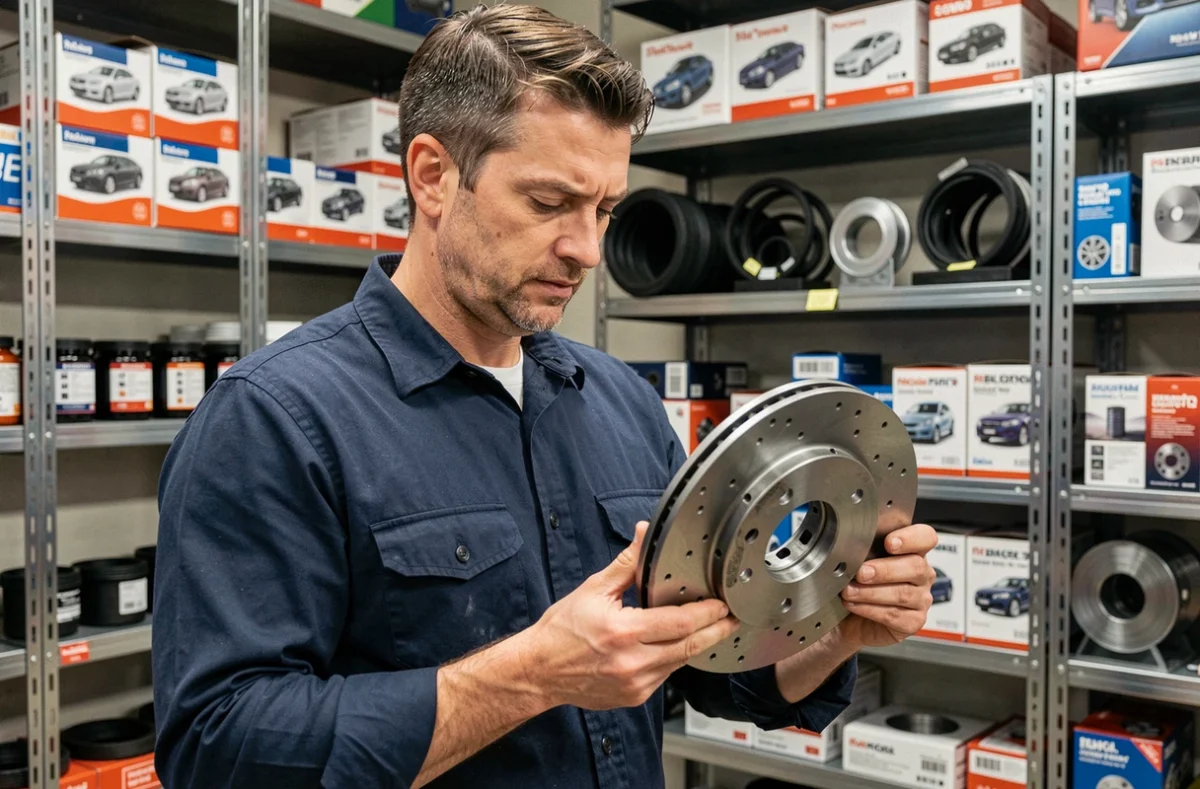
The OEM reference is not always sufficient. Two vehicles of the same model, year, and engine type may have equipment variations related to the series, production location, or an update during the year. Choosing your spare parts and automotive accessories online requires a verification method that goes beyond simply filtering by registration number.
Dimensional tolerance and mounting variations: the trap of adaptable spare parts
An aftermarket part reproduces the dimensions of the original part, but manufacturing tolerances vary from one supplier to another. On a brake disc, a deviation of a few tenths of a millimeter in minimum thickness or centering diameter causes vibrations during braking that the customer mistakenly attributes to a mounting defect.
We recommend systematically comparing the critical dimensions indicated on the product sheet with those of the removed part. Outer diameter, number of holes, bolt spacing, nominal thickness: this data is available in the technical catalogs of leading suppliers (Brembo, TRW, Valeo, Bosch). If the merchant’s site does not mention these specifications, it is a warning sign regarding the seller’s credibility.
For body parts, the situation becomes more complicated. A certified adaptable body part may have a curvature or alignment discrepancy in the mounting points. Online catalogs offering these references on carburauto.fr allow filtering by manufacturer reference, which reduces this risk by cross-referencing the vehicle data with the exact component reference.

OEM reference, VIN, and engine code: three levels of verification for online auto parts
The registration number feeds into a database that identifies the model, engine type, and date of first registration. This first filter eliminates gross errors. It does not cover internal variants.
The VIN remains the most reliable compatibility key. Its 17 characters encode the manufacturing plant, body type, series, and exact model year. A site that offers VIN search directly queries the manufacturer’s parts catalog, not a generic database.
The engine code, engraved on the block or mentioned on the registration document (field D.2), provides a third level of precision for mechanical components: timing belt kit, turbo, injectors, head gaskets. On the same model, two different engine codes sometimes imply incompatible cylinder heads, flywheels, or clutch kits.
- Registration: basic filter, sufficient for common consumables (oil filters, standard spark plugs, wiper blades).
- VIN: necessary for suspension, braking, and steering parts, where manufacturer variants are common.
- Engine code: necessary for timing, injection, turbo, and any internal component of the powertrain.
Legal warranty on reused parts: what changes with the 12-month presumption
The purchase of used parts online is increasing, driven by the obligation for repairers to offer a part from the circular economy when an equivalent alternative exists. For the end buyer, the question of warranty remains the main point of friction.
The presumption of prior defect is reduced to 12 months for a reused part, compared to 24 months for a new item. In practical terms, during the first 12 months, it is the professional seller’s responsibility to prove that the defect did not exist at the time of sale. Beyond that, the burden of proof shifts: the buyer must demonstrate the prior existence of the problem.
This distinction weighs heavily on the economic calculation. A reused part sold at half the price of a new one but guaranteed for half the time is not necessarily a good deal for a heavily stressed component (alternator, air conditioning compressor). However, for a body part or a mirror, the value-for-money of reuse remains relevant.
Checks before ordering on a used parts site
- Does the seller explicitly mention the legal warranty of conformity and its duration on the product sheet?
- Is the mileage of the donor vehicle indicated? A mechanical part from a high-mileage vehicle presents a risk of advanced wear not visible in photos.
- Do the return conditions specify a timeframe and coverage for return shipping in case of non-conformity?
- Is the traceability of the part (serial number, original OEM reference) documented?

New European transparency obligation on automotive accessories: durability and reparability label
By the end of September 2026, a European transparency requirement will come into effect. Online sellers will need to display standardized information on the durability and reparability of components on the relevant product sheets. This obligation includes the commercial warranty of durability, distinct from the legal warranty.
For buyers of spare parts and automotive accessories, the impact is direct. Product sheets will need to clearly state whether a commercial warranty of durability is offered, its duration, and the conditions for claiming it. We observe that the majority of merchant sites have not yet adapted their sheets to this requirement.
A site that already displays this information indicates a higher level of regulatory compliance. It is a more robust reliability indicator than customer reviews, which can be easily manipulated. Conversely, the absence of these mentions after the effective date constitutes a sanctionable breach.
The choice of spare parts and automotive accessories online relies on three verifiable pillars: technical correspondence by VIN and engine code, the warranty framework suitable for the type of part (new or reused), and the seller’s compliance with transparency obligations. A catalog that does not provide these elements before the order generates a risk that the low price does not compensate for.