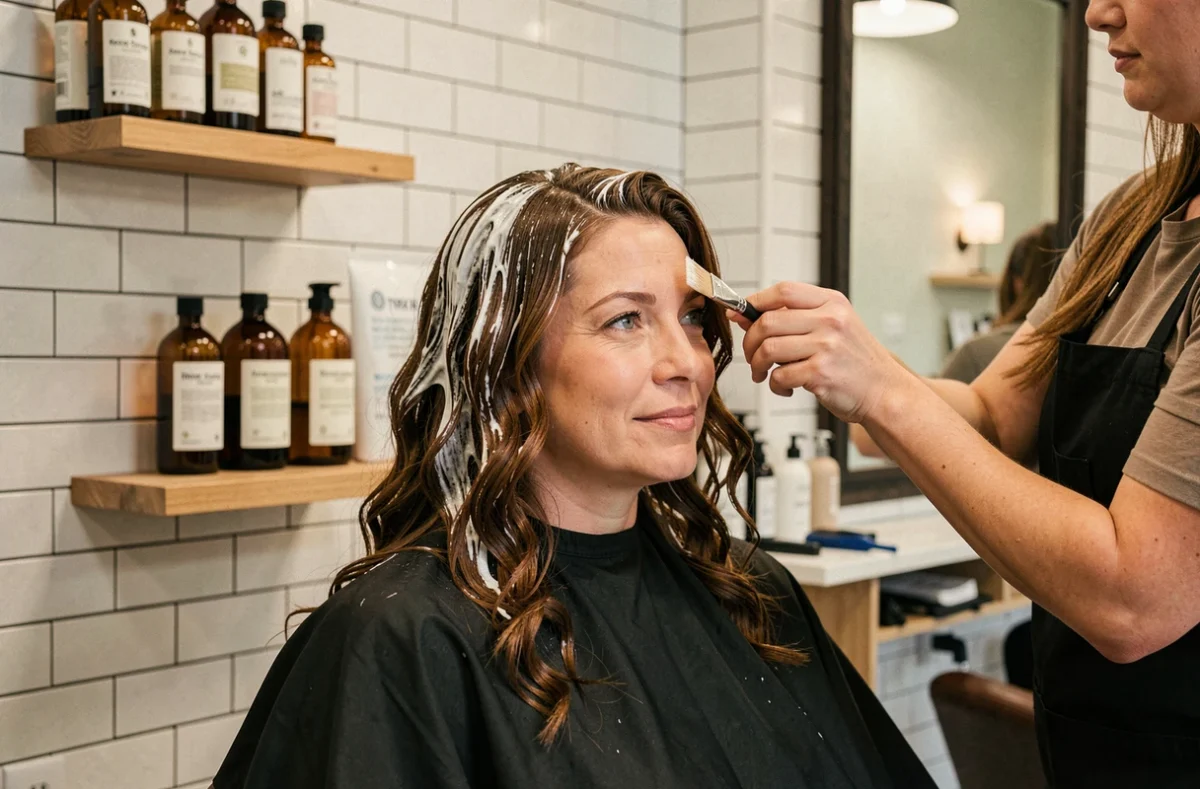
Ammonia-free perm occupies an increasing place in professional catalogs. Brands highlight formulas presented as gentler, enriched with plant keratin or oat extracts. The principle remains the same: to sustainably restructure the hair fiber to create or redefine curls. The promise of a less aggressive treatment deserves to be examined beyond commercial arguments.
Disulfide bonds and pH: what perm really does to hair
Any perm, with or without ammonia, relies on the breaking and then the reforming of disulfide bonds in keratin. A reducing agent opens these molecular bridges to allow the hair to take on a new shape. A neutralizer then closes the bonds in the desired configuration.
Ammonia, in a classic perm, acts as an alkalizing agent: it raises the pH to swell the fiber and facilitate the penetration of the reducer. Removing ammonia from the formula does not eliminate the need for an alkaline environment. Other agents take over, such as monoethanolamine.
The result on the fiber depends on the trio of pH, reducing agent, and processing time. A formula without ammonia but with a high pH, left on too long, can cause as much dryness and porosity as a traditional perm. In other words, removing ammonia does not eliminate the risk of damage.
To delve deeper into the issue of formulations and their trade-offs, hair solutions on Miss Marion detail the chemical mechanisms at play and the associated precautions.
Perm without thioglycolic acid: an advancement or a simple replacement
Thioglycolic acid is the historical reducer for perms. Its characteristic smell and potential irritant properties are well documented. Some recent professional ranges, like Onduly (ASH Professional), claim a formula without ammonia and without thioglycolic acid, relying on plant-derived actives.
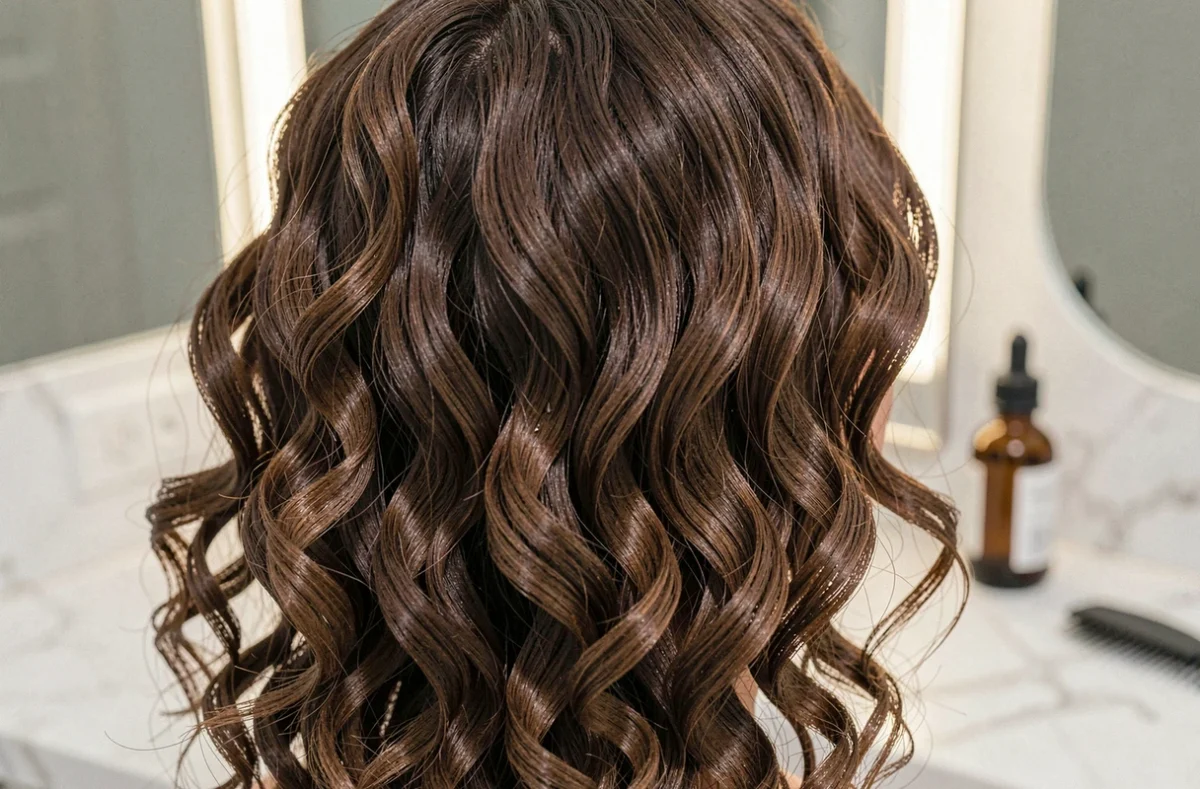
The question arises: what replaces thioglycolic acid, and with what effectiveness on thick or resistant hair? Field feedback varies on this point. On fine or sensitized hair, these gentle formulas seem to provide satisfactory curls with less breakage. On thick hair, the hold may be significantly lower than that of a classic alkaline perm.
A single reducer claimed to be suitable for all hair types simplifies the salon protocol but raises a technical limit: the restructuring strength required varies considerably from one hair type to another. The available data do not allow us to conclude that these universal formulas offer the same curl longevity across the entire hair spectrum.
Acid perm and digital perm: known alternatives and limits
Beyond ammonia-free formulas, two approaches are regularly presented as less aggressive:
- The acid perm, which works at a lower pH (close to neutrality) and uses glycerol monothioglycolate as a reducer. It generally requires an external heat source to activate the product, adding a risk variable in case of poor temperature control.
- The digital perm, popular in Asia, which combines a chemical reducer and heated curlers at controlled temperatures. It produces softer curls with natural drying, but the combination of heat and chemicals can weaken already colored or bleached hair.
- Body wraps or treatments based on cysteamine, sometimes presented as “natural” perms, whose long-term effectiveness remains poorly documented outside of brand communications.
Any technique that permanently reconfigures the fiber can lead to dryness, porosity, and breakage in cases of over-treatment. The determining factor remains the expertise of the professional who assesses the condition of the hair before the treatment, chooses the processing time, and adapts the protocol.
“Ammonia-free” labeling: what cosmetic regulation governs
In Europe, cosmetic products are subject to Regulation (EC) No. 1223/2009, which requires a complete list of ingredients on the packaging (INCI nomenclature). The claim “ammonia-free” is a commercial claim, not a regulatory category.
A product can claim “ammonia-free” while containing alkalizing agents or reducers whose toxicological profile is not necessarily more favorable. The “ammonia-free” label is marketing, not a guarantee of safety. Reading the INCI list remains the only reliable way to identify the actives actually present in the formula.
European labeling requirements for hair products are gradually strengthening, with increased attention to “free from” claims (free from parabens, free from silicones, free from ammonia). These claims must be relevant and not mislead the consumer about the overall safety of the product.
Concrete criteria before choosing a gentle perm
Rather than relying solely on the “ammonia-free” claim, several elements deserve to be checked before committing to a perm:
- The recent hair history: coloring, bleaching, or chemical straightening in the last few months significantly increases the risk of breakage, regardless of the formula used.
- The porosity diagnosis performed in the salon, which conditions the choice of reducer and processing time.
- The INCI composition of the product, particularly the nature of the reducing agent (thioglycolate, cysteamine, other) and the substitute alkalizing agent.
- The documented experience of the stylist with the specific protocol of the chosen range, as the professional touch weighs as much as the formula in the final result.
The ammonia-free perm represents a real formulatory evolution, with less odor, often less irritation of the scalp, and integrated care actives. However, it does not transform a restructuring chemical treatment into a harmless hair care. An informed choice comes from reading the ingredients and a professional diagnosis tailored to the actual condition of the fiber.