For those who love to cook, juggling liquid measurements can sometimes become a real headache. Between milliliters, liters, cups, and fluid ounces, it’s easy to get lost. Fortunately, a few tips and tools can simplify this task.
Accessories like measuring jugs, kitchen scales with liquid functions, or mobile conversion apps are essential for gaining precision and speed. With these practical aids, recipes become more accessible and less intimidating, even for amateurs. Adjusting quantities becomes child’s play, leaving more room for creativity.
The Basics of Liquid Measurement Conversion in Cooking
Understanding the conversion of liquid measurements is essential for successfully following recipes. In cooking, the most common units of measurement are milliliters (mL) and centiliters (cL). To convert these units easily, here are some practical benchmarks.
Correspondence Between Milliliters and Centiliters
- 1 centiliter (cL) = 10 milliliters (mL)
- To convert 400 mL to centiliters: 400 mL = 40 cL
- 1 liter (L) = 100 centiliters (cL)
These conversions are particularly useful for recipes requiring precision in ingredient proportions. For example, when a recipe calls for 50 cL of water, you simply need to measure 500 mL.
Using the Right Tools
To facilitate these conversions, several tools are available. A measuring jug with markings in milliliters and centiliters allows for accurate measurement. Modern kitchen scales often offer a function that allows you to weigh liquids in grams, thus simplifying the conversion process.
Tip for Small Quantities
For small quantities, a tablespoon generally corresponds to 15 mL, or 1.5 cL. This equivalence is handy for quick conversions without the need for complex calculations.
| Unit | Equivalence |
|---|---|
| 1 tablespoon | 15 mL / 1.5 cL |
| 1 teaspoon | 5 mL / 0.5 cL |
Consider these basics of conversion as an asset to optimize your culinary preparations. Precision in liquid measurements ensures consistent and tasty results.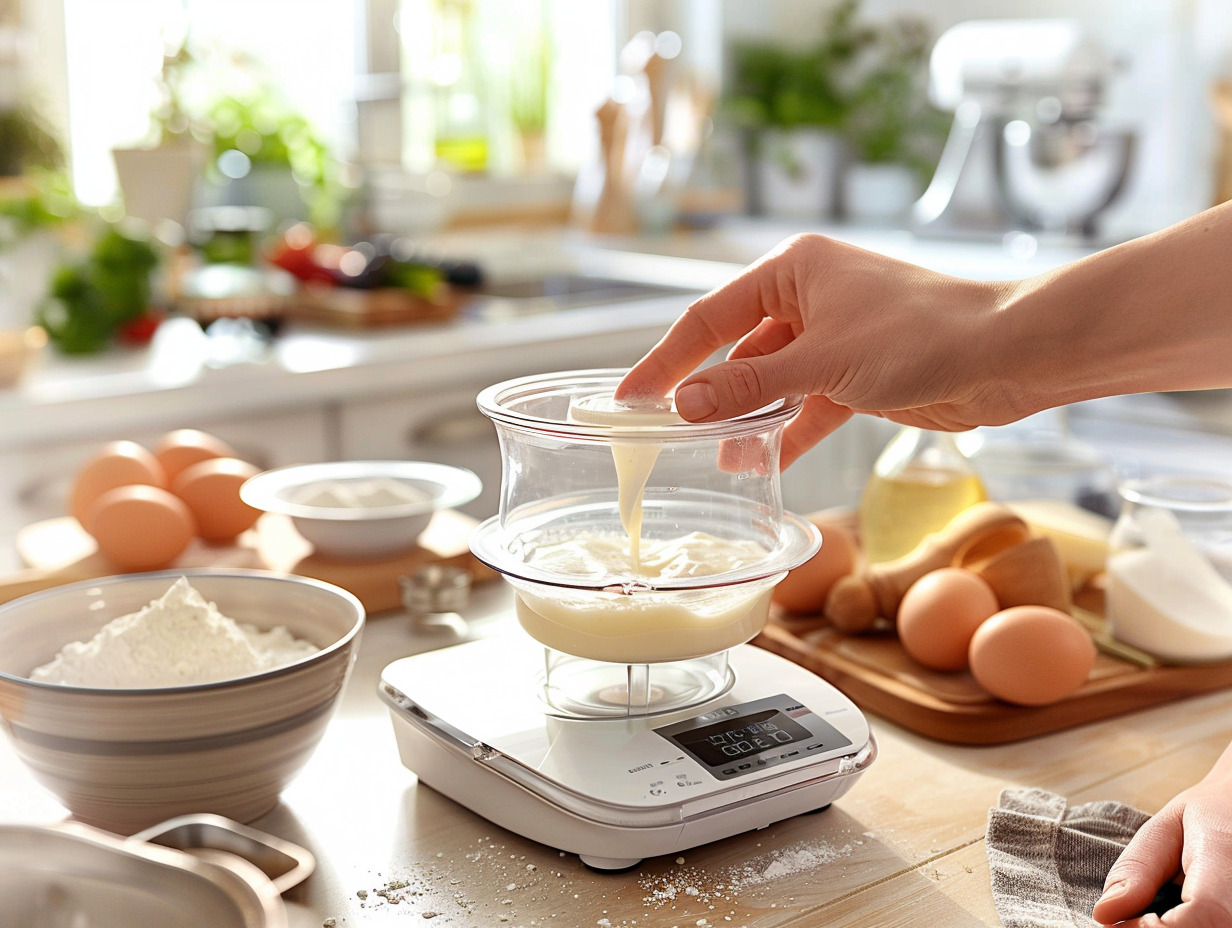
Tips and Tools for Accurate Measurements
Essential Tools
To ensure accurate measurements in cooking, several tools can assist you:
- Kitchen Scale: essential for measuring liquids in grams, and sometimes in milliliters.
- Measuring Jug: allows for easy measurement of different quantities of liquids. Jugs with markings in milliliters and centiliters are particularly useful.
- Measuring Spoons: a tablespoon equals 15 mL, while a teaspoon equals 5 mL. These tools are perfect for small quantities.
Tips to Avoid Mistakes
To minimize conversion errors, here are some practical tips:
- Use a conversion chart: there are many online conversion charts that can help you quickly convert measurement units.
- Check the labels of utensils: some jugs and spoons have inaccurate markings. Ensure the reliability of your tools.
- Double-check: if in doubt, don’t hesitate to verify your conversions with another reliable source.
Mobile Apps for More Precision
Mobile apps can be a great help for making quick and precise conversions. Some apps even offer specific features for cooking, such as converting liquid volumes or real-time notifications to avoid conversion errors. These digital tools can transform your cooking experience, making each recipe more intuitive and successful.