
A lithium-ion battery stored against another battery, terminals exposed, in a drawer or a box: the setup seems harmless, but it concentrates two distinct risks. The first is short-circuiting due to contact between terminals, which can trigger a sudden overheating. The second, less known, is the thermal propagation from a failing cell to its neighbors.
Separating batteries during storage is not an excess of caution: it is a technical precaution that responds to specific physical mechanisms. The following sections delve into the technical reasons, recent insurer requirements, and separation methods suitable for each context.
Thermal propagation between cells: the risk that physical separation reduces
Thermal runaway refers to a self-sustaining temperature rise within a lithium-ion cell. When a cell enters thermal runaway, its temperature can soar to several hundred degrees in a matter of seconds. If a neighboring battery is in direct contact, heat is transferred through conduction and can trigger a chain reaction of thermal runaway.
This phenomenon, known as cell-to-cell thermal propagation, is the scenario that safety standards primarily seek to prevent. A guide dedicated to battery storage on Read it details the situations where direct contact between batteries poses a concrete safety issue. In a storage room, even a distance of a few centimeters between two batteries significantly reduces heat transfer through conduction.
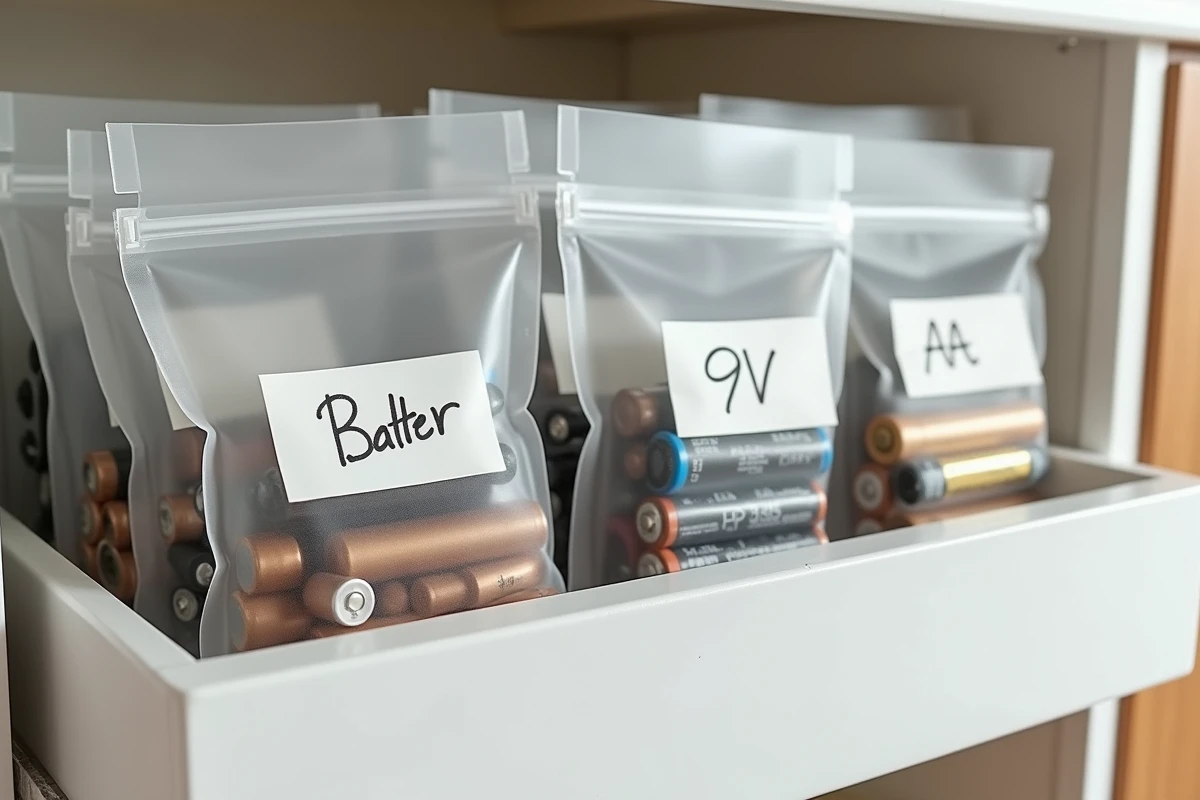
Separation acts as a passive fire barrier. It does not eliminate the risk of a battery failing, but it prevents an isolated incident from becoming a widespread fire. For small batteries (portable tools, electric bikes), placing each unit in a separate space or spacing them on a shelf is sufficient. For traction batteries or solar modules, compartmentalized cabinets are recommended.
Recent insurance requirements for separate storage of lithium-ion batteries
The issue of battery separation goes beyond mere practical advice. France Assureurs recommends in its prevention notes that lithium-ion batteries be stored in dedicated rooms, isolated from other combustibles and separated from occupied areas. This requirement goes far beyond simply avoiding stacking.
The imposed conditions are outlined across several axes:
- Separate batteries by technology type: lithium-ion on one side, lead-acid on the other, as their failure behaviors differ and their decomposition gases are not the same.
- Create distinct zones based on usage: traction batteries (electric vehicle, forklift) separated from small batteries for portable devices.
- Maintain a minimum distance or interpose a fire-resistant compartment between battery lots to limit thermal propagation in case of an incident.
In Germany, the professional association GS has published the GS EK5/AK4 22-01 principle, which defines specific testing requirements for fire-resistant safety cabinets intended for the storage of lithium-ion batteries. This regulatory trend is gradually spreading to neighboring countries.
Failing to comply with these recommendations can affect coverage in the event of a claim. An insurer who observes bulk storage, without separation or an appropriate room, has grounds to contest coverage.
Separating terminals: avoiding mechanical short-circuiting during storage
Thermal propagation concerns failures internal to the cells. External short-circuiting, on the other hand, results from physical contact between the positive terminal of one battery and the negative terminal of another, or between a terminal and a metallic object (key, screw, tool).
This type of short-circuit produces a sudden discharge current. On a lithium-ion battery, the released energy can generate enough heat to trigger thermal runaway. On a lead-acid battery, the main risk is the production of flammable hydrogen gas and the spattering of acid.
Protecting the terminals is as effective as separating the batteries from each other. Several methods work:
- Cover each terminal with an insulating cap or electrical tape before storage.
- Keep each battery in its original packaging or in a non-conductive individual bag.
- Avoid storing batteries in bulk in the same metallic container or in a drawer containing conductive objects.

For rectangular 9V batteries, the risk is higher than for cylindrical formats (AA, AAA), as the two terminals are side by side on the same face. A simple piece of tape on top of the battery eliminates the problem.
Temperature and charge level: two parameters to combine with separation
Separating batteries without controlling their environment remains insufficient. The storage temperature directly influences the chemical stability of the cells. A lithium-ion battery stored in a place exposed to heat (garage in full sun, car trunk in summer) ages faster and presents an increased risk of failure.
The charge level at the time of storage also matters. Lithium-ion batteries are better stored at a partial charge, around half of their capacity. A battery stored at full charge undergoes permanent electrochemical stress that degrades its electrodes.
A battery stored empty risks dropping below the minimum voltage threshold and becoming unusable, a phenomenon known as deep discharge.
For lead-acid batteries, the logic is reversed: they should be stored charged and benefit from periodic maintenance charging to avoid plate sulfation. A maintenance charger plugged in during the storage period prevents this degradation.
The combination of these three parameters (physical separation, moderate temperature, appropriate charge level) forms the foundation of reliable storage, whether the battery powers a seasonal vehicle, a gardening tool, or a home solar system.
The last point to remember concerns periodic checking. A battery stored for several months can slowly discharge due to natural self-discharge. Checking the voltage every two to three months helps avoid unpleasant surprises when it comes time to reactivate it.